How to water balcony plants without dripping onto the space below
· Editorial team newsfromatlanta24.com
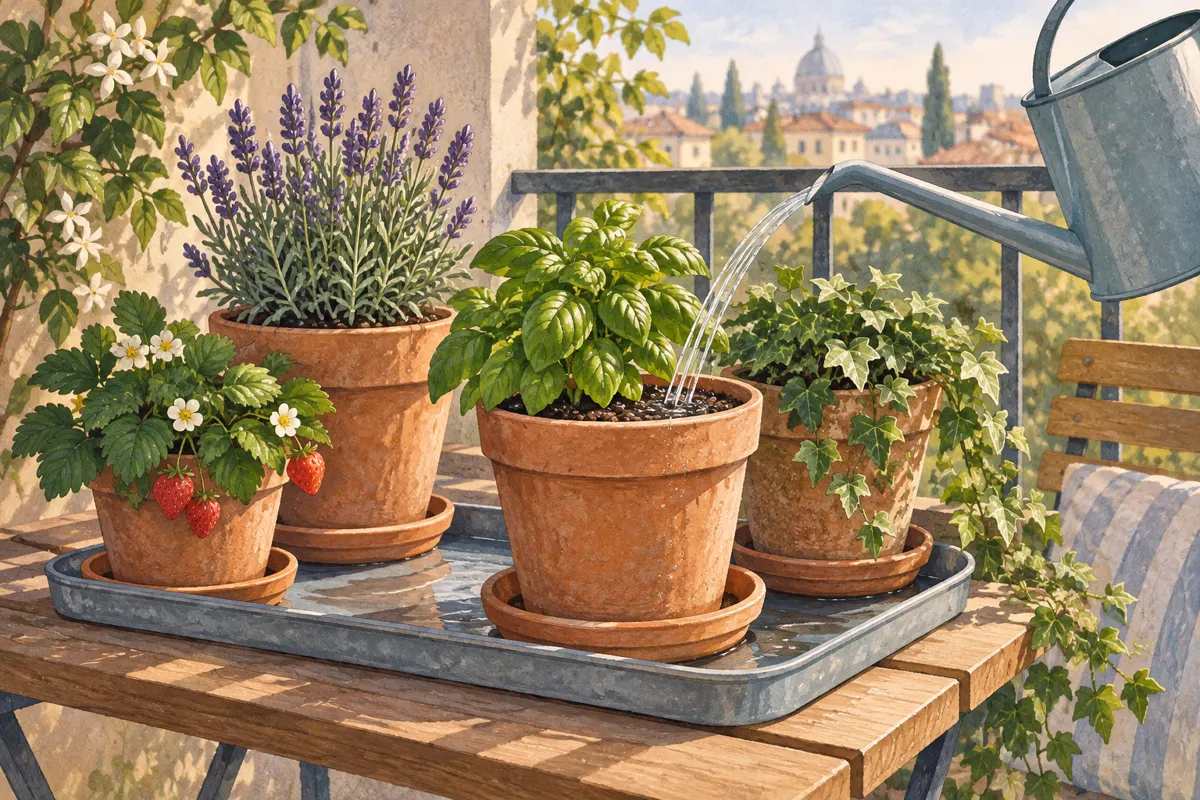
To water balcony plants without dripping below, catch runoff in a saucer or removable tray, pour slowly in small amounts, and empty the collected water after the pot drains. Keep drainage holes open: the aim is to contain escaping water, not trap it around the roots. The following is a proposed practical routine for making balcony watering easier to control.
Give each pot a place to drain
Start with the path water takes out of the container. A pot can look neatly positioned while its drainage holes sit beyond the edge of a small saucer. Choose a stable catchment that extends beneath every drainage opening, and make sure you can remove it or empty it without tipping water over the balcony.
- Use an individual saucer beneath a freestanding pot.
- Place several small pots in a removable tray with a raised rim.
- For a long planter, use a matching tray that catches water along its full length.
- If a decorative outer pot collects runoff, lift out the inner pot so you can empty it.
Check saucers and trays for cracks before relying on them. Keep containers within the balcony boundary, where runoff can be caught and reached. If a railing planter drains directly outside the balcony and has no accessible catchment, move it to a contained watering spot when it needs water, provided it is safe to lift.
Water slowly and watch the first runoff
Small pours give you time to see where the water goes. They do not mean every plant should receive only a tiny drink. The total amount still needs to suit the plant, its container, and the moisture already in the potting mix. Check each pot rather than giving the whole balcony an identical dose.
- Check the potting mix and the plant’s watering requirements before adding water.
- Position the saucer or tray and check that it is empty.
- Pour a small amount onto the potting mix, using a narrow spout for control.
- Pause to let the water soak in, then add more if needed.
- Watch beneath the pot. If runoff appears, pause and check the catchment before continuing.
Avoid pouring so quickly that water spills over the pot’s rim. If water pools on the surface, wait before adding another pour. Keep a cloth nearby for splashes, but use the tray to handle drainage; a cloth alone is not a dependable runoff container.
Empty the catchment while preserving drainage
Once drainage has slowed, empty the saucer, tray, or outer pot. Carry collected water indoors in a suitable container rather than tipping it across the balcony floor. Recheck the catchment afterward, since water may continue to emerge while you are tending other plants.
Do not plug drainage holes as a way to stop dripping. An ordinary draining pot needs an outlet for excess water. Likewise, avoid leaving its base sitting in collected runoff. A purpose-built reservoir planter is a different arrangement: follow its filling and overflow instructions rather than treating an ordinary saucer as a permanent tank.
For a heavy container, choose a catchment you can empty while the pot stays securely in place. If your setup requires an awkward lift every time, revise it before the next watering. Easy access makes the emptying step more manageable.
Use a removable watering station for awkward pots
Our proposed option for small, movable containers is a temporary watering station: a sturdy waterproof tray placed on a level surface inside the balcony. Bring pots to it individually, water them there, and return them to their usual positions once runoff has slowed.
This can help with hanging pots or containers whose normal saucers are difficult to reach. Keep the tray away from the balcony edge and leave room to carry it without sloshing. Do not move a planter that is too heavy or awkward to handle safely; provide accessible containment beneath it instead.
Check automatic watering for overflow too
Drip kits, watering cones, and reservoir containers are options for balconies without a tap. Drip systems deliver water through outlets near the plants, while reservoir containers store water within the planter. Their suitability depends on the plants and the setup. Gardena describes these approaches in its balcony watering guide.
For drip prevention, our proposal is to observe a complete watering cycle before leaving any system unattended. Check connections, drainage outlets, and how much water reaches the trays. Keep overflow routes contained and accessible. Automatic delivery still needs a workable plan for any water that escapes the pot.